
Reliable internet is one of the most important business utilities in 2026. From cloud applications and video conferencing to cybersecurity tools and remote work infrastructure, nearly every business operation depends on stable, high-speed connectivity.
Choosing the right business internet provider is not just about download speed. Companies also need to evaluate reliability, uptime guarantees, upload speeds, customer support, scalability, and pricing. Fiber internet is increasingly preferred because of its symmetrical speeds and stronger performance for cloud-based workloads.
In this guide, we’ll compare the best business internet providers, analyze their strengths, pricing structures, and help you determine which provider is the best fit for your organization.
What Makes a Great Business Internet Provider?
Business internet needs differ significantly from residential internet.
How to Choose the Right Cloud Computing Provider for Your Business (2026 Guide)Companies should evaluate:
- Download speed
- Upload speed
- Network reliability
- Service Level Agreements (SLAs)
- Customer support
- Static IP options
- Security features
- Scalability
- Contract flexibility
- Backup connectivity options
For businesses using cloud applications, VoIP systems, remote teams, or large file transfers, upload performance can be just as important as download speed. Fiber providers often deliver symmetrical upload and download speeds, making them particularly attractive for modern businesses.
Best Business Internet Providers in 2026
1. AT&T Business Fiber
Best for Speed and Fiber Performance
AT&T Business Fiber is widely considered one of the strongest options for businesses that require high-performance internet.
AT&T offers fiber plans with symmetrical speeds and supports demanding workloads such as cloud computing, video conferencing, large file transfers, and remote collaboration.
Best Password Managers for Businesses and Enterprise Teams (2026 Guide)Key Features
- Fiber internet
- Symmetrical upload and download speeds
- Business-grade support
- Static IP options
- Dedicated internet services
- Advanced network security options
Pros
- Excellent fiber performance
- Strong upload speeds
- Good customer satisfaction ratings
- Suitable for cloud-based businesses
Cons
- Fiber availability varies by location
Speed Range
Typically:
- 300 Mbps to 5 Gbps+ depending on availability
Best For
Businesses that prioritize speed, cloud applications, and remote work.
2. Verizon Business
Best Overall Business Internet Provider
Verizon Business continues to rank highly because of its combination of fiber, 5G business internet, reliability, and nationwide business support.
Many reviews consider Verizon one of the strongest overall providers thanks to its symmetrical fiber speeds and strong reliability.
Cybersecurity Insurance Cost: What Businesses Need to KnowKey Features
- Verizon Fios Business Internet
- 5G Business Internet
- Static IP options
- Network security services
- Business continuity solutions
Pros
- Excellent reliability
- Strong fiber performance
- Good remote work support
- Flexible connectivity options
Cons
- Fiber coverage remains limited in some regions
Speed Range
Typically:
- 200 Mbps to 2 Gbps+ for fiber plans
Best For
Businesses seeking a balance of speed, reliability, and scalability.
3. Comcast Business
Best for Availability
Comcast Business remains one of the most widely available business internet providers in the United States.
Broadband industry reviews frequently rank Comcast Business highly because of its broad coverage, scalable plans, LTE backup options, and business support services.
Top Endpoint Protection Solutions for Enterprise Security (2026 Guide)Key Features
- Cable and fiber internet
- LTE backup options
- SecurityEdge protection
- Managed networking
- Voice and collaboration services
- 24/7 support
Pros
- Wide availability
- Flexible business plans
- Strong service ecosystem
- No data caps on many plans
Cons
- Upload speeds may be lower on cable plans
- Customer satisfaction varies by region
Speed Range
Typically:
- Up to 2 Gbps+ depending on location and connection type
Best For
Businesses located outside major fiber markets.
4. Spectrum Business
Best for Small Businesses
Spectrum Business offers relatively simple pricing and broad coverage for small organizations.
Key Features
- Business internet
- Phone services
- Managed Wi-Fi
- Security services
- Static IP options
Pros
- Broad availability
- Competitive pricing
- No data caps on many plans
- Easy deployment
Cons
- Upload speeds are often lower than fiber competitors
Speed Range
Typically:
- Up to 1 Gbps depending on market
Best For
Small businesses that need affordable connectivity.
5. T-Mobile for Business Internet
Best Wireless Business Internet Option
T-Mobile continues expanding its business-focused fixed wireless internet services.
For companies that cannot access fiber or cable infrastructure, wireless internet may provide a cost-effective alternative.
Key Features
- 5G business internet
- Wireless deployment
- Backup connectivity
- Business support services
- Quick installation
Pros
- No complex installation
- Good for remote locations
- Flexible contracts
- Fast deployment
Cons
- Performance depends on network coverage
- Speeds can fluctuate
Best For
Remote offices, temporary locations, and small businesses.
6. EarthLink Business
Best for Uptime Guarantees
EarthLink remains a strong option for organizations seeking reliable business connectivity.
Some industry comparisons highlight EarthLink’s high-speed offerings and uptime guarantees as major advantages.
Key Features
- Fiber internet
- Managed networking
- Business voice services
- Security solutions
- Dedicated support
Pros
- Strong uptime guarantees
- Business-focused services
- Multiple connectivity options
Cons
- Availability varies significantly by region
Best For
Organizations that prioritize reliability.
Business Internet Provider Comparison
| Provider | Best For | Speed Range | Connection Type |
|---|---|---|---|
| AT&T Business Fiber | Speed and cloud workloads | 300 Mbps – 5 Gbps+ | Fiber |
| Verizon Business | Overall performance | 200 Mbps – 2 Gbps+ | Fiber / 5G |
| Comcast Business | Availability | Up to 2 Gbps+ | Cable / Fiber |
| Spectrum Business | Small businesses | Up to 1 Gbps | Cable |
| T-Mobile Business | Wireless internet | Varies by coverage | 5G Fixed Wireless |
| EarthLink Business | Reliability | Up to 5 Gbps | Fiber |
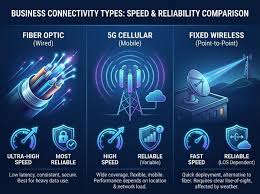
Fiber vs Cable vs Wireless Business Internet
Fiber Internet
Fiber is generally considered the best option for businesses.
Advantages
- Symmetrical speeds
- Low latency
- Excellent reliability
- Better cloud performance
- Strong scalability
Disadvantages
- Limited availability in some regions
Fiber is often recommended for businesses using cloud infrastructure, VoIP, remote collaboration, and large-scale data transfers.
Cable Internet
Cable remains widely available and often costs less than dedicated fiber.
Advantages
- Broad availability
- Competitive pricing
- High download speeds
Disadvantages
- Lower upload speeds
- Shared network congestion
5G Fixed Wireless
Wireless business internet continues improving rapidly.
Advantages
- Fast deployment
- No major infrastructure installation
- Flexible contracts
Disadvantages
- Variable performance
- Coverage limitations
Wireless internet is often best as a backup connection or for smaller locations.
How Much Business Internet Speed Do You Need?
Small Office (1–10 Employees)
Recommended:
- 100–300 Mbps
Suitable for:
- Cloud applications
- Video calls
- Basic VoIP
Growing Business (10–50 Employees)
Recommended:
- 500 Mbps – 1 Gbps
Suitable for:
- Multiple video conferences
- Cloud storage
- File sharing
- CRM platforms
Large Office (50+ Employees)
Recommended:
- 1–5 Gbps
Suitable for:
- Heavy cloud workloads
- Remote desktop environments
- Large-scale collaboration
- High-volume data transfers
Reliability and Uptime Matter More Than Speed
Many businesses focus only on speed, but downtime is often more expensive than slower internet.
Reliable providers typically offer:
- 99.9% uptime guarantees
- Service Level Agreements
- Priority support
- Network monitoring
- Backup connectivity options
Industry experts consistently emphasize uptime and reliability as key business internet selection criteria.
Security Features to Consider
Business internet providers increasingly include security services.
Look for:
- DDoS protection
- Managed firewalls
- Secure DNS
- Threat monitoring
- Static IP options
- VPN support
Some providers also bundle cybersecurity services with connectivity plans.
Factors That Affect Business Internet Pricing
Pricing varies based on:
- Speed tier
- Connection type
- Location
- Contract length
- Dedicated bandwidth
- Static IP requirements
- Managed services
Typical monthly costs:
| Business Size | Estimated Monthly Cost |
|---|---|
| Small Office | $70–$250 |
| Medium Business | $250–$1,000 |
| Larger Business | $1,000–$10,000+ |
Dedicated fiber circuits can cost significantly more depending on SLA requirements.
Best Business Internet Provider by Use Case
Best Overall
Verizon Business
Strong balance of speed, reliability, fiber, and 5G services.
Best Fiber Internet
AT&T Business Fiber
Excellent symmetrical speeds and cloud performance.
Best Availability
Comcast Business
One of the widest business internet footprints in the U.S.
Best Small Business Option
Spectrum Business
Simple plans and broad market coverage.
Best Wireless Internet
T-Mobile for Business
Strong fixed wireless alternative for underserved locations.
Best Reliability
EarthLink Business
Known for business-grade uptime guarantees.
Final Thoughts
The best business internet provider depends on your location, infrastructure availability, performance requirements, and budget.
For businesses with fiber access, AT&T Business Fiber and Verizon Business are among the strongest choices because of their symmetrical speeds, cloud performance, and reliability. Businesses that prioritize availability often choose Comcast Business, while Spectrum Business remains a practical option for smaller organizations. Companies operating in remote locations may benefit from T-Mobile Business Internet, while organizations that require maximum uptime should evaluate EarthLink Business.
As cloud computing, cybersecurity, AI tools, and remote work continue to expand in 2026, investing in reliable business internet is no longer just an IT decision—it is a critical business growth decision. The right provider can improve productivity, strengthen customer experience, and reduce costly downtime for years to come.